SB9 Explained: The Detailed Guide to Unlocking Property Value
SB 9 Explained: The Complete California Homeowner’s Guide to Lot Splits, Duplexes, and Unlocking Property Value
California SB 9: The Opportunity Most Property Owners Still Don’t Understand
Since taking effect on January 1, 2022, California Senate Bill 9 (SB 9) has quietly become one of the most powerful residential development tools available to homeowners, investors, and families throughout California.
Yet despite being in effect for several years, most property owners still do not fully understand what SB 9 actually allows, whether their property qualifies, how many units can be built, or how the lot split process works.
Some people think SB 9 simply allows a duplex.
Others think it automatically allows four homes on every property.
The reality is more nuanced—and significantly more powerful when utilized correctly.
At LA PLAN MAN, we regularly evaluate properties throughout Southern California to determine whether SB 9 can create additional building opportunities, increase property value, facilitate multi-generational housing, or create new investment potential.
This guide breaks down everything you need to know about SB 9, urban lot splits, duplex development, eligibility requirements, common misconceptions, and how to determine whether your property qualifies.
What Is SB 9?
Senate Bill 9 (SB 9), officially known as the California HOME Act, was created to help address California’s housing shortage by allowing more residential development on qualifying single-family properties.
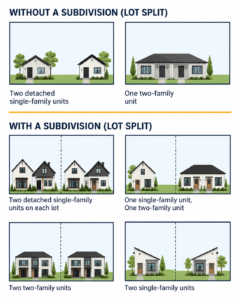
The law created two major development pathways:
1. Two-Unit Development
SB 9 allows a qualifying single-family parcel to be developed with up to two primary residential units.
This means a property that may have previously allowed only one single-family home can potentially contain:
-
- Two detached homes
-
- A duplex
-
- Attached units
-
- Converted units
-
- A combination of existing and new construction
2. Urban Lot Split
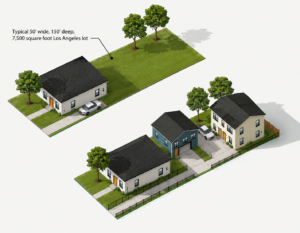
SB 9 also allows qualifying single-family parcels to be subdivided into two separate legal lots through a streamlined ministerial process.
Once split, each new parcel may potentially contain up to two primary dwelling units.
This is what creates the tremendous development potential that has attracted homeowners, developers, and real estate investors across California.
What Does “Ministerial Approval” Mean?
One of the most important aspects of SB 9 is that qualifying projects are reviewed ministerially.
In simple terms:
You should not need:
-
- Public hearings
-
- Planning commission approvals
-
- Neighborhood votes
-
- Discretionary entitlement processes
Instead, if the project satisfies the objective standards established by state law and local regulations, the city must generally approve the project administratively. This streamlined approval process is one of the most valuable aspects of SB 9.
For homeowners, this can significantly reduce entitlement risk compared to traditional subdivision and development processes.
Understanding the Difference Between SB 9 and ADUs
One of the most common misconceptions is confusing SB 9 with California’s ADU laws.
They are not the same.
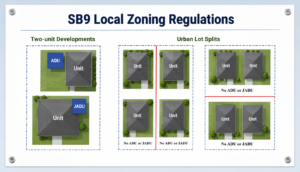
ADU Laws
ADU regulations allow:
-
- Accessory Dwelling Units (ADUs)
-
- Junior ADUs (JADUs)
These units are subordinate to a primary residence.
SB 9
SB 9 creates additional primary residential units.
The distinction is important because primary units often carry greater development value and flexibility than accessory units.
Understanding how SB 9 and ADU regulations interact can dramatically affect the overall development potential of a property.
The Four Development Scenarios Under SB 9
Scenario 1: Keep Existing House and Add One New Home
Many homeowners choose the simplest path.
They retain the existing residence and construct a second primary dwelling on the same parcel.
Benefits include:
-
- Minimal subdivision complexity
-
- Retention of existing residence
-
- Additional rental income
-
- Housing for family members
Scenario 2: Build a Duplex
A qualifying lot may be developed with two primary units.
These units can often be attached or detached depending on site conditions and local standards.
This approach can substantially increase housing capacity while avoiding the lot split process.
Scenario 3: Split the Lot
An SB 9 urban lot split creates two separate legal parcels.
After subdivision, each lot may contain one primary dwelling.
Benefits include:
-
- Creation of a second legal lot
-
- Increased resale flexibility
-
- Potential financing advantages
-
- Independent ownership opportunities
Scenario 4: Split the Lot and Build Two Units on Each Parcel
This is the scenario most people associate with SB 9.
A qualifying parcel is divided into two lots.
Each resulting lot may contain up to two primary dwelling units.
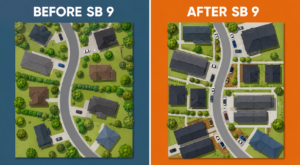
This can create up to four primary homes where only one was previously allowed.
Not every property can efficiently achieve this outcome, but when feasible, it often represents the highest-value development strategy.
What Properties Qualify for SB 9?
Not every parcel is eligible.
The first step in any SB 9 feasibility study is determining eligibility.
Generally speaking, a property must:
-
- Be located within a qualifying urbanized area
-
- Be zoned for single-family residential use
-
- Meet state eligibility requirements
-
- Avoid certain environmental and historical restrictions
Several site-specific factors can disqualify a property.
These may include:
-
- Historic districts
-
- Certain environmental protection areas
-
- Conservation easements
-
- Protected habitat areas
-
- Certain flood hazard zones
-
- Certain wildfire hazard conditions depending on local circumstances and mitigation requirements
Every property should be individually evaluated before assuming SB 9 eligibility.
Minimum Lot Size Requirements
One of the most important aspects of an SB 9 lot split is parcel size.
State law generally requires:
-
- Each resulting lot to be at least 1,200 square feet
-
- Neither lot to be smaller than approximately 40% of the original parcel size
This effectively creates a “60/40” split limitation.
For example:
A 10,000-square-foot parcel could generally be split into:
-
- 6,000 square feet
-
- 4,000 square feet
But not:
-
- 8,000 square feet
-
- 2,000 square feet
Understanding lot dimensions, setbacks, access requirements, easements, and utility locations becomes critical when evaluating feasibility.
The Three-Year Owner Occupancy Requirement
One of the most misunderstood aspects of SB 9 involves owner occupancy.
For urban lot splits, applicants generally must sign an affidavit stating they intend to occupy one of the housing units as their principal residence for at least three years following approval of the lot split.
This requirement was included to discourage speculative subdivision activity and encourage owner participation in housing creation.
Many investors discover this requirement too late.
A professional feasibility study should identify these obligations early in the planning process.
Parking Requirements Under SB 9
Parking standards are often more favorable than traditional development standards.
In many cases, local agencies may require no more than one parking space per unit.
Additionally, parking requirements may be reduced or eliminated for properties located near qualifying transit corridors or major transit stops.
This can significantly improve development potential on smaller urban lots.
Setbacks and Design Flexibility
SB 9 also provides flexibility regarding setbacks and development standards.
Local jurisdictions may establish objective standards, but those standards generally cannot physically prevent the construction of the units SB 9 authorizes.
The law was intentionally designed to prevent local agencies from creating standards that effectively eliminate the housing opportunities SB 9 was meant to create.
Can You Use SB 9 More Than Once?
No.
An SB 9 urban lot split may generally only occur once on a parcel.
Additionally, there are restrictions intended to prevent serial lot splitting and subdivision gamesmanship involving adjacent properties.
This makes it important to design the subdivision correctly the first time.
Poor planning can permanently reduce the future value and development potential of the property.
Common Mistakes Property Owners Make
At LA PLAN MAN, we frequently see property owners make the same mistakes.
Mistake #1: Assuming Every Lot Qualifies
Many do not.
Environmental restrictions, access issues, lot configuration, and local conditions can all impact eligibility.
Mistake #2: Focusing Only on Lot Size
Lot size matters, but:
-
- Access
-
- Easements
-
- Utilities
-
- Setbacks
-
- Existing structures
-
- Fire access
can be equally important.
Mistake #3: Designing Before Running Feasibility
Many homeowners spend thousands on plans before determining whether the lot can actually be split.
Mistake #4: Ignoring Utility Infrastructure
Water, sewer, electrical service, and utility separation can dramatically impact project costs.
Mistake #5: Using Generic Plans
Every SB 9 property is unique.
The highest-value solution for one lot may be completely wrong for another.
Why an SB 9 Feasibility Study Matters
Before spending money on architecture, engineering, surveys, or permit applications, property owners should understand what is realistically achievable.
A proper SB 9 feasibility study typically evaluates:
-
- Zoning
-
- Existing site conditions
-
- Lot dimensions
-
- Easements
-
- Utility availability
-
- Fire access
-
- Setback constraints
-
- Environmental restrictions
-
- Potential unit count
-
- Development yield
-
- Highest and best use strategy
The goal is simple:
Determine the most profitable and realistic development path before investing significant capital.
Is SB 9 Worth It?
For many California property owners, the answer is yes.
SB 9 may provide opportunities to:
-
- Increase property value
-
- Create rental income
-
- Build homes for family members
-
- Develop multi-generational housing
-
- Create additional saleable lots
-
- Increase long-term investment returns
However, not every property is a good candidate.
Some parcels are ideal.
Others may be better suited for ADUs, traditional subdivisions, or other development strategies.
The key is understanding the property before making decisions.
How LA PLAN MAN Can Help
SB 9 projects are not just about drawing plans.
Successful projects require a coordinated understanding of:
-
- Zoning regulations
-
- Urban lot split requirements
-
- Parcel mapping
-
- Site planning
-
- Building design
-
- Utility coordination
-
- Engineering requirements
-
- City approval processes
At LA PLAN MAN, we help homeowners, investors, builders, and developers navigate the entire process from concept to permit-ready plans.
Our services include:
-
- SB 9 feasibility studies
-
- Site evaluations
-
- Urban lot split planning
-
- Construction plan drafting
-
- Permit expediting
-
- Engineering coordination
-
- Soils report coordination
-
- Survey coordination
-
- Development consulting
Whether you’re trying to determine if your property qualifies, exploring a duplex project, or evaluating a full SB 9 lot split with multiple new homes, our team can help identify the highest-value path forward.
Ready to Find Out What Your Property Can Do?
If you own property anywhere in Southern California and want to determine whether SB 9 can unlock additional development potential, contact LA PLAN MAN today.
We’ll evaluate your property, explain your options, identify potential challenges, and help create a realistic roadmap for moving your project forward.
The biggest mistake property owners make with SB 9 is assuming.
The smartest move is finding out exactly what your property is capable of before investing time and money.
Contact LA PLAN MAN today and let us help you unlock the hidden potential of your property through California’s SB 9 program.



Related Posts

ADU Grants in California: The Complete Guide to Funding Your ADU in Los Angeles & Southern California